






Sore After Reformer Pilates
If you are sore after reformer Pilates, especially after your first few classes, you have not done anything wrong. The reformer loads muscles most people never train directly, through ranges they rarely use, under constant tension from the springs. Your body notices.
What matters is knowing the difference between the ordinary ache of muscles adapting and the kind of pain that is telling you to stop. This guide covers why it happens, where you will feel it, how long it lasts, what actually helps, and how to train so you are less sore next time.
In this article
Why reformer Pilates makes you sore
The ache you feel a day or 2 after a class is usually delayed onset muscle soreness, the normal response of muscle to work it is not used to. The reformer is particularly good at producing it for 3 reasons.
Time under tension. The springs never switch off. On the way out you are pushing against them and on the way back you are controlling them, so the muscle is working through the whole rep, including the slow lowering phase that tends to cause the most soreness.
Unfamiliar muscles. Inner thighs, deep glutes and the stabilising muscles around the hips and shoulders get very little direct work in daily life or in most gym programs. The reformer targets them on purpose.
Long ranges. Many reformer exercises take a muscle through a longer range than you normally use it. Working a muscle while it lengthens is one of the most reliable ways to wake it up the next day.
So if you have come from running, cycling or weights and still find yourself walking strangely after a reformer class, that is not a sign you are unfit. It is a sign the class found something your usual training misses.
Where you will feel it
Most people feel it in the same handful of places, and each one points back to a particular kind of reformer work.
Inner thighs. The most common surprise. Footwork with heels together, side splits and anything with the legs in straps all ask the adductors to work hard, and they are rarely trained anywhere else.
Glutes. Bridging, standing work and kneeling exercises load the glutes through a long range. Expect to feel them on stairs the next day.
Abs. The hundred, ab curls and anything where you hold your legs up in tabletop keep the deep abdominals working for longer than most people are used to. It often shows up when you laugh or cough.
Hamstrings. Feet in straps, especially circles and frogs, work the back of the legs in a lengthened position.
Arms and upper back. Rowing and arm work in the straps load the back of the shoulders and the triceps, which is why light springs can feel surprisingly heavy by the end of a set.
Calves and feet. Footwork on the balls of the feet and heel raises work muscles that are usually just along for the ride. If you want to understand what footwork is really doing, our reformer Pilates footwork guide breaks it down.
How long it lasts
Ordinary muscle soreness usually arrives the day after a class rather than straight away, tends to be at its worst on the second day, and eases over the following few days.
The first 2 or 3 weeks are when it is most noticeable. As your muscles adapt to the work, the same class produces less and less soreness, which is why the second time you do a particular class almost always feels kinder than the first.
Soreness can come back when you change something. A new class, a heavier spring, more sessions in a week or a return after time off can all bring it back for a few days. That is normal and it settles the same way.
Normal soreness or a warning sign
Normal soreness is a dull, tender ache in the belly of a muscle. It is uncomfortable to stretch or press on, it eases as you warm up and move, and it improves day by day.
These are different, and worth taking seriously.
- Sharp, stabbing or sudden pain, especially if you felt it during the class
- Pain in or around a joint rather than in the muscle, particularly the knees, lower back or shoulders
- Swelling, bruising or a joint that feels unstable
- Pain that gets worse rather than better after 3 or 4 days
- Numbness, tingling or pain that travels down an arm or leg
- Soreness so severe you struggle with normal daily movement, or dark coloured urine after a very hard session
If you have any of these, stop training that area and see a physiotherapist or your GP. I am not a medical professional and this is not medical advice, but I would always rather someone took a week off and got checked than trained through something that turns out to be an injury.
What actually helps
There is no trick that makes soreness disappear overnight. What helps is mostly simple, and mostly free.
- Keep moving. Gentle movement is the most reliable relief. A walk, an easy bike ride or a short mobility session increases blood flow and usually makes stiff muscles feel looser within minutes.
- Do some easy stretching. Gentle, comfortable stretching of the sore area feels good and helps you move more freely. Do not force it. Our guide to the best reformer Pilates moves for flexibility has plenty of gentle options.
- Sleep properly. Most of the repair happens while you sleep. A short night after a hard class is the quickest way to feel worse for longer.
- Eat enough protein. Your muscles need it to rebuild. You do not need anything special, just a decent serve of protein across your meals.
- Drink water. Being well hydrated will not cure soreness, but being dehydrated will not help it either.
- Use warmth if it feels good. A warm shower or bath before bed relaxes tight muscles for a lot of people. Use whatever makes you comfortable.

Should you train when you are sore
Usually yes, just not the same way.
Mild soreness is not a reason to stop. A lighter session on the same muscles often helps, and a session that works different areas is completely fine. What you want to avoid is repeating a hard class on muscles that are still very sore, because the quality of every rep drops and that is when form starts to slip.
A good rule is to rate the soreness out of 10. At 1 to 3, train as normal and expect it to ease once you warm up. At 4 to 6, go lighter on the springs or train a different area. At 7 or above, take an active recovery day with walking, mobility or gentle yoga instead.
This is exactly where shorter sessions earn their place. A 10 minute reset or a gentle yoga flow keeps your routine going without loading muscles that need another day. If you are wondering how often to train overall, our guide to how many times a week to do reformer Pilates lays it out, and if you are tempted to go every single day, read what happens if you do reformer Pilates every day first.
Fit by FitBoutique
Sore today? Do 10 minutes instead of nothing
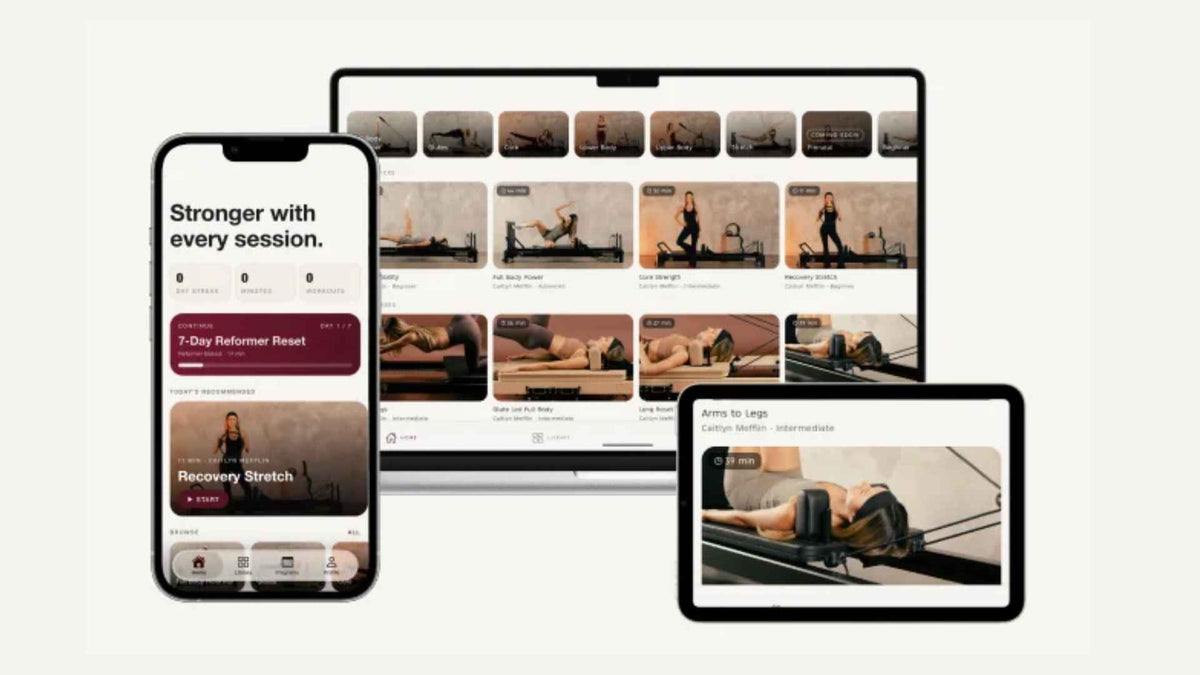
The Fit app has 10 minute resets, mat and yoga classes for recovery days, and full reformer classes for when you are ready to push again, all taught by real instructors on your phone, tablet or TV. Try every class free for 7 days.
Start Your Free Trial

How to be less sore next time
You cannot avoid soreness completely, and you would not want to, because a little of it means the work was new enough to be worth doing. But you can stop it from wrecking your week.
Build up slowly. In your first fortnight, 2 sessions a week is plenty. Jumping straight to 4 or 5 is the most common reason new reformer users are miserable by day 6.
Change one thing at a time. A new class, heavier springs or an extra session are each fine on their own. Doing all 3 in the same week is asking for it.
Warm up properly. A few minutes of easy footwork and spinal movement before the hard work gets blood into the muscles you are about to load. Our reformer Pilates warm up takes about 5 minutes.
Go up in springs gradually. Add load when the last 2 reps of a set feel controlled, not because the person next to you is using more. Our guide to Pilates reformer spring settings explains how to judge it.
Repeat classes. The second time through a class almost always hurts less than the first. A program that repeats and progresses is kinder to your body than a different random class every day.
A Note From Ayrah
The one place you should not be sore after reformer Pilates is your neck. If you are, it is not soreness to wait out, it is a cue to change how you are doing your ab work.
I had a sore neck after every class for my first month and assumed it was normal. It was not. In every ab curl and every hundred, I was hauling my head up with my neck instead of lifting from my ribs, and my abs were barely doing anything.
What fixed it was embarrassingly simple. I started looking at the space between my knees rather than at the ceiling, imagined holding a small piece of fruit under my chin, and let my head rest in my hands whenever the exercise allowed it.
Within 2 weeks the neck ache was gone and my abs were sore instead, which is exactly the right way round.
Frequently Asked Questions
Is it normal to be sore after reformer Pilates?
Yes, especially in your first few weeks, after a new class or after going up in springs. The reformer keeps your muscles under constant tension and works areas like the inner thighs, glutes and deep abdominals that rarely get direct training, so a dull ache the next day is very common.
Why are my inner thighs so sore after reformer Pilates?
Because footwork with the heels together, side splits and leg work in the straps all ask the adductors to work hard, and very little else in daily life or the gym trains them directly. It is one of the most common places new reformer users feel it.
How long does soreness after reformer Pilates last?
Usually it appears the day after, peaks around the second day and eases over the next few days. It is most noticeable in your first 2 or 3 weeks and fades as your body adapts to the work.
Should I do reformer Pilates if I am still sore?
If it is mild, yes. Go lighter on the springs or train a different area. If it is severe, take an active recovery day with walking, mobility or gentle yoga, and come back once it has eased.
Does being sore mean it worked?
Not necessarily. Soreness tells you the work was new, not that it was effective. As you get stronger you will feel less sore after the same class, and you will still be making progress.
When should I worry about pain after reformer Pilates?
See a physiotherapist or your GP if the pain is sharp, sits in a joint rather than a muscle, comes with swelling, numbness or tingling, or gets worse rather than better after 3 or 4 days.
Keep Moving On The Sore Days
Recovery classes, 10 minute resets and full reformer workouts from real instructors. Start with 7 days free.
Start Your Free Trial
Written by Ayrah Yuso
I'm part of the FitBoutique team and have a solid passion (and love) for all things exercise related, including Reformer Pilates


















Leave a comment